Writer’s Conundrum: Experience vs. Imagination

The age-old maxims states:  “write what you know,” and, indeed, many of us do write from experience.  This is true even within the genre of speculative fiction.  In fact, it may be especially true in speculative fiction.  The more fantastical our worlds and characters, the more important it becomes to ground them in something that feels, if not real, at least possible.  We might be writing about lovelorn giant squid or misunderstood zombies, but we often base them and their worlds around people we know or places we’ve been.

So, it stands to reason that  in order to keep our imaginations fresh, engage our readers, and seek new fodder for characters and world-building, we must continue to have new experiences.

A small example that set me thinking about this:  a few weeks ago I participated in my first-ever poker game (I know, I know…I need to get out more).  During a hand where I’d folded and was waiting out the action, I started pondering how I might write a story about a game of poker without it actually being about people sitting around playing poker.  The next day I wrote a draft of a tale that follows a high stakes poker game unfolding across the entire landscape of a post-apocalyptic, magic-shrouded Manhattan.  The experience of playing poker for the first time inspired me to write something new.

But here’s the rub:  while some new adventures are free and can be worked around or into our busy schedules, most of them aren’t (even the game of poker cost me a buy-in).

Another example:  I’m currently working on a novel set in the high plateaus of central Mexico.  Though I’ve spent a lot of time in other parts of Central America, I’ve never been to Mexico.  Sure, I’ve done research, found images and descriptions, listened to recorded sounds of native animals, and talked to my archaeologist friends who’ve done work in the region.  But that isn’t the same as experiencing the landscape firsthand.  I don’t know how those deserts smell, or what they look like at different times of day, or how sounds carry across the dry, open spaces.

Of course, this is where imagination in comes in.  And imagination can take you a long way, but still…those experiences are what help bring our writing to life.

So how do we prioritize?  Is it better to spend our time and money on sword-fighting lessons and books about military strategy to improve those battle scenes, or would a trip to the region where the novel is set pay bigger dividends?  Do you need to pay the money to shoot guns at a firing range in order to write a realistic gun fight?  Can another person’s words help you write a description of the Himalayas that exhilarates the reader even if you’ve never experienced that exhilaration yourself?

What’s the balance between creativity, imagination, and experience?  How important are new sights, sounds, tastes, and smells to nourishing our writing?  Or do you think it’s all bunk and a writer can get everything they need from research, interviews, and the rich soil of their own mind?

What do you think?  And what are your tricks for accruing experiences without emptying your bank account and getting fired from your job?
Writer’s Workspace: 11/16

Good morning and welcome to this writer’s workspace.  Here’s what’s happening liiiiiiiive at Miranda’s desk:

What I’m working on: Today’s a NaNoWriMo day, so I’m plowing ahead on the first draft of “Absent (see “Miranda’s Writing” for a synopsis).  So far, I’ve written 21,000 words in 15 days, but I’m still over 5,000 words behind.  I hope to eat away at that deficit today.

Snippet from the page: “Nick’s first impression was a blinding glare–the sun overhead.  Then the cold.  It pressed greedy fingers against every inch of exposed skin.  He gasped and the air bit deep into his lungs.  Emily’s hand still clutched his, and he saw Reid crouched nearby, his hands against his knees and vomit trailing in the wind.  Brittle, tundra-like grasses sprouted in miserable clumps, bent down in submission to the wind.  A jagged line of mountains loomed in the distance.”

Keeping me company: Mr. Ramses (The Overseer) has turned his attention to guarding the borders of his domain.  At least he’s not trying to steal my chair this morning.

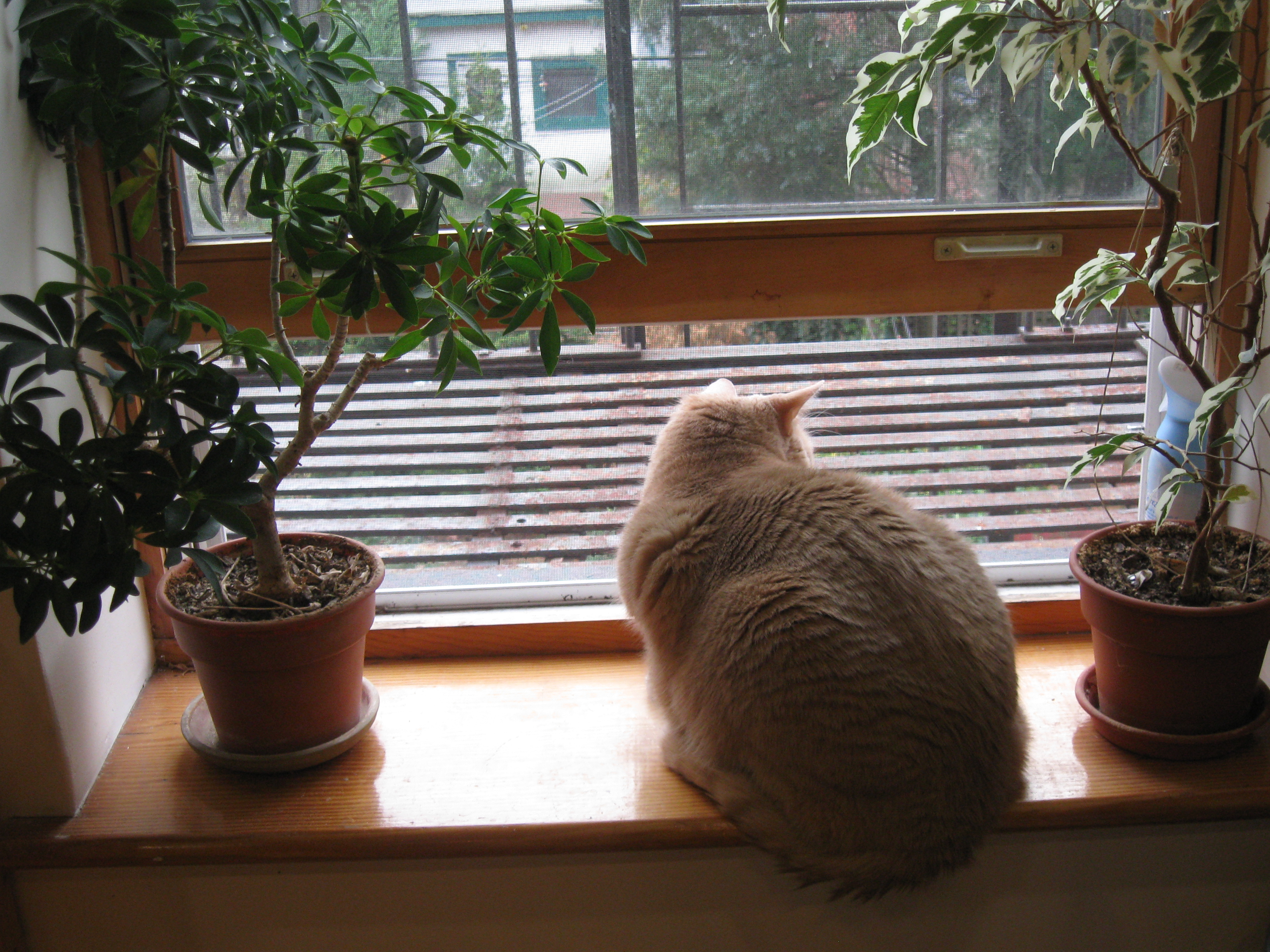
Patrolling the borders

On the iTunes: Instrumental soundtracks are great for novel writing.  Right now I’ve got the Main Title (House Atreides) from Children of Dune playing.

Out the Window: it’s warm today, for a November, but miserable and gray.  The forecast promises “soaking rains.”  This might actually be inspiring since I need to write several scenes set in Ice Age Wyoming.

In my mug: Empty! Gah!  I’m contemplating a second cup of Irish Breakfast, but it’s still early.  Must. Pace. Myself.

A Little Procrastination Never Hurt Anyone: a few links to share today….Catherine Schaff-Stump on the love of writing, Scalzi reminds us to nominate books for the Nebula, and The Ferrett on the importance of working your writing muscle.  Enjoy.

Well, that’s all from here folks!  What are you up to today?

Those voices in your head

As many of us know, the act of getting a story out of our heads and onto the page requires forcing the two unruly siblings living our in our brains — the uptight, fussy Internal Editor and the wild, emotive, elusive Beast — to work together.

I’ve long known (and squabbled with) my old frenemy, the Internal Editor, but I didn’t have a term for describing the Beast until I went to Viable Paradise and heard Laura Mixon lecture about the ancient, buried part of your brain that plucks patterns from a web of emotions, sensations, and evolutionary cunning.   It is from here that the well of creativity springs to nourish our storytelling.

For me, activating the Internal Editor is a breeze.  In fact, sometimes it’s a bit too easy; before I know it I’m putting off advancing the plot in favor of obsessing over the structure of a single paragraph.  As I’ve already blogged about, this year I’m trying NaNoWriMo for the first time, and the experience has brought the push and pull between the Editor and the Beast into even sharper focus.  After all, the point of NaNo is to shut the Editor up altogether and let the Beast have free reign to drive the story along at top speed.

On the one hand, I’ve found it physically painful not to go back over what I’ve written.  It’s hardwired in my DNA (perhaps a hold-over from grad school days?) to tweak the wording, revise the dialogue, and insert new scenes to shed better light on the characters and their behavior.  Plus, I staunchly maintain there’s solid value in this type of revision — more often than not, editing can help illuminate the path ahead and open doors to new plot developments you wouldn’t have otherwise found.

On the other hand, embracing the NaNo approach (as best I can) has liberated my Beast.  Telling the Editor to shut up and just pour the story onto the page without looking back is thrilling.  And the stuff that comes out is often surprising.  Of course, it can also lead thousands of words in the wrong direction, fingers taping in a frenzy of Beast-driven madness.  When I come back to myself, I find my characters have said stupid things and done even stupider things, and the Internal Editor is waiting, hands on his hips, saying “I told you so.”  Which sucks.

The real trick, I think, is to get your Beast to talk to you while you aren’t writing.  Coaxing him out and encouraging him to whisper yet-unrevealed plot secrets is about as hard as getting a cat to perform tricks.  I find it happens (the coaxing of the Beast, that is, not the cat tricks) most often when I’m in the thick of working on a project but am currently doing something else – especially something requiring minimal active engagement with the world around me.

For instance, in the last week, my Beast has visited me with gifts while I was:

  • sitting on the subway staring at my own reflection in the window against the blackness of the tunnel
  • sitting under a dryer at the hair salon with my head full of color foils (and without my glasses on, rendering me essentially blind)
  • walking outside on a route so familiar I didn’t need to look where I was going

In all three instances, I fell into a sort of trance and followed the Beast down new and deliciously twisty avenues of storytelling in my novel.  When I snapped out of it, for a moment I had forgotten where I was.  It’s possible I was even talking to myself (which on the New York City subway would put me in good company).

Thus far, my Beast flat-out refuses to appear when directly invoked, so, naturally, none of these episodes of Beast-contact were activated on purpose.  Nor did any of them happen when I had a pen and paper convenient to hand.  Thanks a lot, Beast.

Though, I’m finding there are certain activities that will usually lure him from hiding – including long walks and (ugh) trips to the gym.  Washing dishes, folding laundry, and ironing are also good bets.  Maybe the Beast just likes a clean house?

What are your tricks for getting your Beast to communicate with you?

Drafting and Revising: Patience really is a virtue

Congratulations!  You’ve had a genius idea for a story.  You’ve even managed to get it all written down, more or less in order.  You’ve gone over it once or twice, tweaking the wording, deleting pesky adverbs and restructuring awkward paragraphs.  You went so far as to print it out, read it aloud, and fix everything that sounded stupid.

Awesome! You’re ready for feedback.

No, I’m sorry my friend, but you are not.

get out your editor's pen!

I’ve learned this lesson the hard way several times.  It’s natural, of course, to finish up a newly drafted story and want instant feedback.  Or, worse yet, to want to cross “submit to market” off your to-do list.  Natural, but a big mistake.

A better strategy is to set that story aside.  Forget it exists.  Do this for a minimum of a week, two if you can bear it–solitary confinement in the filing cabinet.  Then pull it back out and give it a read.  Chances are the first line will strike you as horrible.  If you make it to the third paragraph you’ll probably have found at least five instances of “that” you can cut.  You may have also realized nothing happens on the entire first page.

Crap.

This is why patience is a virtue.  Draft.  Set aside.  Revise.  Repeat.  Then send it out to your writer’s group.  Only then will your story be at a point where higher level feedback will be valuable.  Plus, your writer’s group will thank you for doing the extra revisions 🙂

This one is always hard for me.  I love my new stories (after all, their newness makes them awesome by default).  They’re like perfect newborn ducks, fluffy and delicate.  I want to send them into the world so that everyone can see how amazing they are, how brilliant.  But I’m too close to them to recognize their awkwardness or see that they aren’t yet capable of swimming, let alone flight.  Maybe, just maybe, if I nurtured and fed them and waited for them to grow a little they might not get eaten by the neighborhood dog.

Just sayin’.

NaNoWriMo, where’s the love?

This is my first year giving NaNoWriMo a try and one thing that has surprised me is the general chatter out there regarding whether NaNo is for “real” writers or not (by which folks generally seem to mean published pros).  My feeling is that every writer, newbie or pro, will benefit from the practice of daily writing, so I’m frankly not sure what the fuss is all about.  Nevertheless, here are my thoughts on NaNoWriMo’s pros and cons:

NaNo’s advantages:

  • I’m nearing the end of Week 2 and am several thousand words behind of where I should be to “finish” on time…but, I’ve also written about 15K, thereby kick-starting a novel I might have otherwise never begun (and one I’m really enjoying writing).  Whether I reach 50K by the end of the month or not, I’m chalking this up as a win.
  • I write, revise, research, or otherwise work on my writing regularly, but the habit of putting down 2000 or so new words every day is a valuable one to develop.  NaNo has helped me develop this habit.  Again, a win.
  • Lets be honest, we all have goals we’d like to meet that fall forgotten into the gutter where they molder and die alone.  But when we announce those goals to the world at large, post our progress on a website, and read about the progress of our friends on Twitter, Facebook, and the like…well, the social pressure of something like NaNo can be very motivating (though also occasionally disheartening).  It’s a little embarrassing to see your buddies’ word counts grow while your status bar just sits there stagnating.  I’d be willing to bet social pressure plays a pretty big a role in how many people “win” NaNo.

And, for the cons:

  • The biggest drawback of NaNo, in my view, is that when you’re cranking out 50,000 words in one month and the NaNo cheerleaders are shouting “keep going!” “don’t edit!” “go!”…well, you get a frantic sort of feeling that isn’t conducive to reflection and revision.  There’s more to drafting a novel than just word count.  Giving yourself time for ideas to percolate, mutate, and grow into something more twisty and gorgeous than you first envisioned is an important part of the drafting process.  NaNo might not be the best means to facilitate plot and character development.

Some are quite critical of NaNoWriMo and say it’s a waste of time engaged in by only unprofessional writers who will produce mostly drivel.  While I don’t doubt a huge quantity of drivel is produced by writers during the month of November (and could provide whole passages of said drivel from my own manuscript), there are also plenty of examples of novels that go on to be finished after NaNo ends (50K is not really novel length, after all), revised, edited and eventually published (famously, Water for Elephants by Sara Gruen, but also (for speculative fiction fans) Shades of Milk and Honey by Mary Robinette Kowal and many others).  For many of these authors, the salient point is that NaNo provides a forum for setting a meaningful deadline and getting that first draft (or a big portion of it) down on paper.

NaNoWriMo isn’t really about finishing a novel in a month.  It’s about publicly shaming yourself challenging yourself to internalize what really amounts to a professional writing behavior: getting down a daily word count.  This is the advice that EVERYONE gives newbie writers: write, write, write.  Try to carve out 30 minutes, an hour, whatever, each day and write.  All NaNoWriMo is doing is saying to try this for a whole month.  All the rest about finishing a novel and so on and so forth is just window dressing.

So, bottom line.  If you struggle with producing a regular, daily word count and you want an external task-master (ah, that ever-helpful social pressure) to assist you in making it a habit, NaNoWriMo is an excellent tool for achieving your goal.

That’s my two and a half cents.  What are your thoughts on NaNo?

Writer’s Workspace: 11/10

Good morning!  Welcome to this writer’s workspace.  Here’s what happening liiiiiiiiive at Miranda’s desk:

What I’m working on: Revisions to the second draft of my novel “A Blood Red Sun.”  I’ve made it nearly to the midpoint of the book and am gearing up for the next major section that needs work – the big battle where the protagonist loses spectacularly.

Snippet from the screen: “The little girl studied him a moment longer, weighing things.  He waited.  The light was almost gone and night would soon fall.  Shadows nibbled at the girl’s edges, swallowed up the hut whole.”

On the iTunes: “Heart of Gold”, Neil Young

In my mug: cold dregs of Dunmore East Irish Breakfast tea

Out my window: dishwater-gray sky, the last of the fall leaves.  Brooklyn seems torn between malingering in late fall and proceeding into early winter.  I say: make up your damn mind!

Keeping me company: The Overseer (aka Mr. Ramses, my very fat cat)


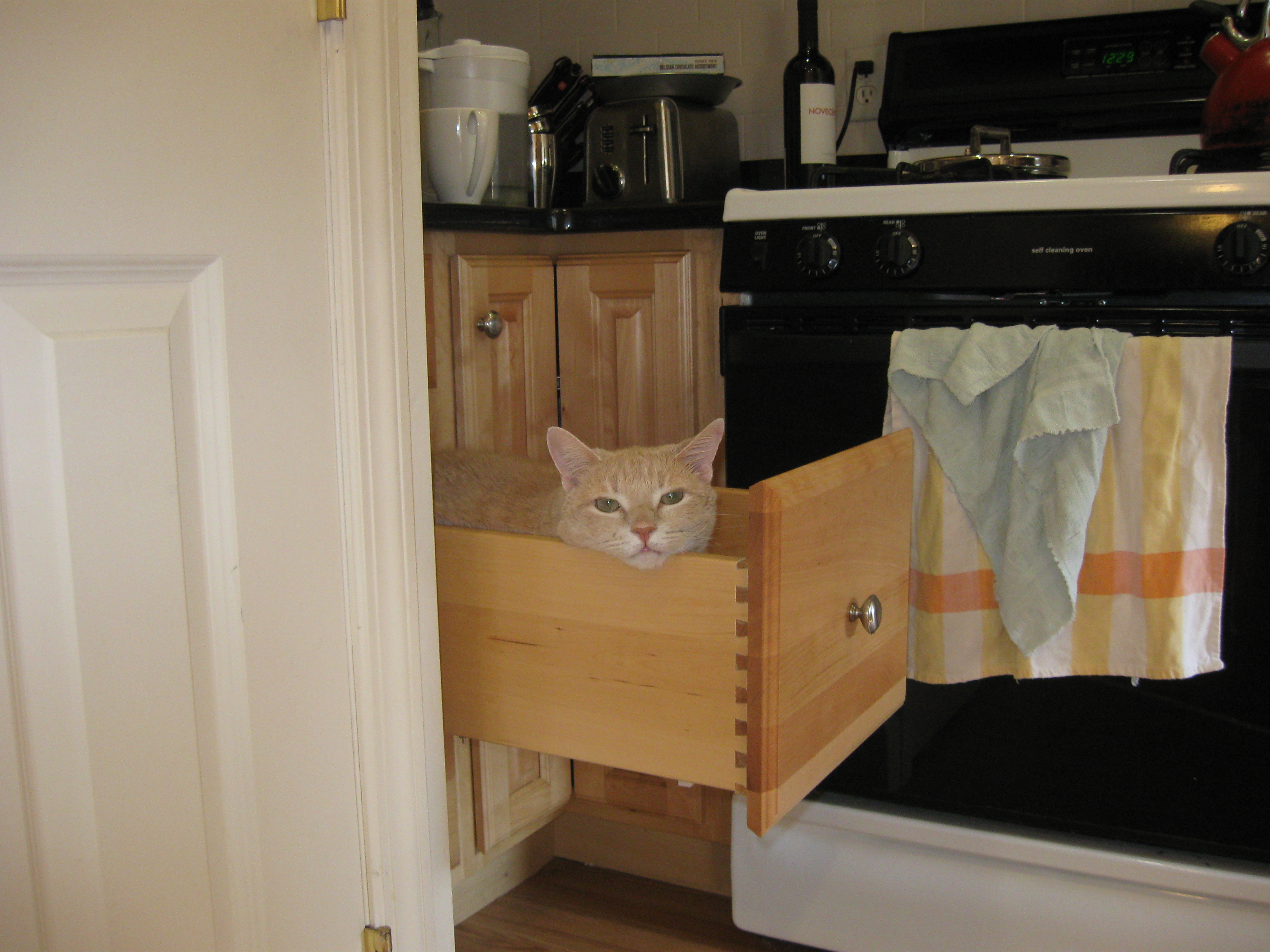
"The Overseer" keeps an eye on me from the kitchen

That’s all from here, folks.

What are you working on?

Yes, but is it realistic?

Lately, I’ve been pondering the role of grit and realism in the fantasy genre.  How little is too little?  Is there such a thing as too much?  And what does “realism” mean when it comes to fantasy, anyway?

It’s Joe Abercrombie’s “Best Served Cold” that got me thinking about this in the first place.  For those who haven’t read it, or who aren’t familiar with his excellent First Law series, Abercrombie populates his tales with characters real enough to make you despair for the fate of humanity.  Whether they’re obsessed, driven, or shiftless, his characters are pretty much all self-centered, deeply flawed, and prone to violence.  Their adventures make for good, if sometimes bleak, reading, but his books have also made me wonder if there’s such a thing as too much realism.

If Tolkein’s misty elves and noble kings-in-exile are at one end of the “realism” spectrum, then Abercrombie’s characters fall at the far, far distant extreme.  You may get pulled along by his stories, immersed in his highly believable worlds, and even come to root for certain of the characters, but there’s little chance you’d actually want to spend time with any of them.  They are, by and large, not nice people.

This very fact, of course, is what makes Abercrombie’s characters so human – they’re jealous and petty and do spiteful things.  They act against their own interests because they just can help it.  They almost never change themselves for the better and almost always resolve their problems by running away, stabbing someone in the back, or just stabbing someone, period.  We read about them and we recognize the baser, less lovable parts of ourselves.

This kind of writing, let’s be honest, is rare in the fantasy genre.  I mean, most of the stuff out there falls into the “brave band of heroes” camp, without reflecting much on who the heroes are slaughtering (after all, they’re the good guys, so it must be justified).  So, there’s an important place for Abercrombie’s kind of fiction.  But sometimes I wonder if he’s left out the most human elements of all from his characters.  Sure, his books have a smattering of forgiveness and loyalty, the occasional shred of redemption, and even a rare hint that people are capable of loving someone other than themselves.  But such aspects of human nature are few and far between.

Is that realism?  I don’t know, but I really hope not.  Don’t get me wrong, I enjoy Abercrombie’s books and I will continue to devour them when they’re released.  But I don’t think they’re realistic.

I guess some people might find it odd to pair the ideas of “realism” and “fantasy” at all.  By definition, fantasy is the unreal, is that which we imagine.  But the best fantasy strives to make its imaginary worlds feel like they could be real places and its characters act in the complex and often contradictory ways that real humans do.

Consider George R.R. Martin’s Songs of Ice and Fire.  Here are characters that (to me) feel realistic.  The conniving and murderous are still capable of love, even if that love is twisted.  The honorable and brave can be stubborn and blind, their nobility dooming both themselves and others to death.  Jealousy can lead to kindness, love to betrayal.  Nor are these characters free of the mundane realities of being living animals.  They eat and vomit and shit and suffer and screw–and Martin’s descriptions of these acts leave nothing to the imagination.  You believe his characters are experiencing what they do not because he tells you, but because he shows you with unrelentingly realistic prose.  Martin, of course, is not alone in writing this kind of fiction.  Of the things I’ve read recently, both Steven Erikson’s Malazan series and David Anthony Durham’s “Acacia” both come to mind.

Personally, I’m of two minds about how to incorporate realism into my writing.  On the one hand, I have a generally low opinion of humanity as a whole.  Our history reflects poorly on us, unless war and violence against the weak is what we’re striving for.  And yet, we’re obviously capable of creating beautiful things, too.  Plus, on an individual level, people may be cruel one minute and commit breathtaking acts of self-sacrifice, kindness, and love the next.  We engage in both groan-inducing predictability and devilish unpredictability.

It’s possible that we err in focusing only on characters here.  This may be as much about world-building as character-building.  Perhaps our worlds should better reflect the rapaciousness of humankind and our characters better embody the contradictory and stutter-stop urges towards a more noble ideal.

What do you think?  Are Martin and others like him hitting the right notes of realism for you, or do you prefer Abercrombie’s grittier fare?  Can our characters have some good sprinkled in with their bad and still feel real?  Do we need to be careful of over-emphasizing nuanced “realer than real” characters at the expense of building honest-feeling worlds?

Blog Rising

I’ve been doing some dithering, and even some hemming and hawing.  But I’ve finally decided it’s time to start my own blog.

So, you may be wondering:  what am I going to blog about?  What gems do I have to share with the world and thus with you, dear Reader?

Well, I’m a writer of speculative fiction, following the tap-tap of my laptop keys through worlds fantastical, science fictional, and macabre.  This blog will be about my writing life.  I’ll share my thoughts on learning and mastering the craft of writing, on giving and receiving critiques, and on my experiences as I journey the fraught and often peril-filled road towards becoming a professional writer.  I’ll even post occasional snippets from whatever I’m working on…just for your special reading pleasure 😉

If you write, chances are good you also consume books whole, devouring them like they’re covered with  bacon, or maybe chocolate (you know, if bacon’s not your thing).  I certainly do.  So I’ll weigh in from time to time on the books I’m reading and the books I’m avoiding and on the general state of speculative fiction.

Finally, since the writing life cannot be separated from the “day job life” and the “home life” and…well, you get the idea…I’ll also venture to comment on these intersections if the mood so strikes.  You just never know.

So….stay tuned!