Edit me: tricks for revising

As many of you know, I recently finished my second novel, BLOOD RED SUN.  Part of this process involved a lot of serious revising and editing.  Awhile back, I wrote a post about some of the changes I felt I needed to make and how I approached revising as a process.  Today I follow up on that post by sharing the revising and editing tricks I used.  I make no special claims at expertise here,  but merely share things I found useful in the hopes that you may too.

Revising and editing a novel poses two major differences from revising a short story: 1. keeping track of of all the different threads in the novel, and 2. getting through its not-inconsiderable bulk without losing focus.  For the former, the use of a diagram or spreadsheet can be really useful; create rows for each chapter and columns for its setting, the characters present, the action that occurs, the character development that occurs, and so forth.  I use strikethrough and different colors to keep track of changes.

When it comes to keeping focus, I create a hierarchy of revisions – big stuff (plot changes, character development, and so on) first, followed by smaller changes (improvement of setting, fine-tuning description details, etc.), and, finally, editing.  Then, for each type of revision, I make multiple passes through the manuscript.

In the final revisions of BLOOD RED SUN I had several areas I knew I wanted to revise.  One was to improve the textural feel of the world (the sights, sounds, tastes, and so forth).  Another was to work on bringing out my protagonist’s thoughts and feelings; showing her emotions through her actions and reactions.  Doing both of these things at once seemed daunting, so I separated them and gave my full attention to each in different passes through the novel.  This might seem like it would take more time, but it actually speeds things up — you move through each chapter more quickly because you are working on just one thing, and one thing only.

Still, during an editing pass I sometimes find I can maintain clear-eyed focus for only a few chapters.  At that point, I stop being able to edit and just start reading.  When you’re reading, your eyes tend to skip over small errors and you forget exactly what it is you were supposed to be looking for in the first place.  Worse, you get fatigued and the earlier chapters end up being much more highly revised and edited than the later ones.

One way to overcome this challenge is to break the novel up into non-contiguous sections.  A trick I found effective was to revise randomly.  I wrote all the chapter numbers on little slips of paper and put them in a bowl.  I’d draw one, revise whatever chapter was listed, and then draw another.  This kept me from getting pulled into the story and allowed me to focus on the book in little sections, really honing my editing knife.

When I draft, I also often leave bits unwritten.  These bits are peppered throughout the novel, written in brackets, and colored red to remind me of their languishing and unloved state.  An example: [insert DESCRIPTION OF THE CAMP here] or [look up SPECIES OF SNAKE].  During revision I have to go back and fix all these bad boys.  Many of them tend to be description related and it can get tough to think up beautiful new descriptions off the cuff.

To solve this problem, I create master documents with descriptions of the world.  BLOOD RED SUN was a desert world, so I had fifteen different ways of describing the sand, twenty-five different ways of describing cactus (plus a list of all the species of cactus), ten different ways of talking about the way morning light hits the mountains, how the air smells after it rains, and so on.  As I went through the manuscript, I’d use these descriptions in appropriate places, marking them off on the master sheet so I wouldn’t repeat them.  This worked so well for me that I actually ended up doing separate sheets for descriptions of the various cities, of the clothing people wore, and of the food they ate.

Finally, for the smallest level stuff – fixing typos, excising excess words, and tightening the prose — I used the method laid out in the 10% Solution (a genius little book).  Here you use the search function in your word processing program to focus on a single word (“that” or “of” or “was”, for instance).  You go through each and every instance of this in the novel and decide whether to revise, remove, or keep the offending sentence.  This is sooooo tedious, BUT it really works because it forces you to focus at the level of the sentence without any other distractions, something you could never do if you were reading as opposed to using ‘search’.  The method is called the 10% Solution because it usually results in you axing about 10% of your word count (all of it flab).

So, those are my tricks:

  • Using a spreadsheet to keep track of your plot lines, characters, and arcs
  • Making multiple passes, each focused on a very specific type of revision
  • Chopping the novel up into sections and editing them randomly as opposed to reading through them in order
  • Using master sheets for world-building (descriptions, sights, sounds, smells, tastes, etc)
  • Using the 10% Solution to hone the manuscript into a lean, mean machine

What do you think – do any of these things sounds helpful?  Are you already doing some of them?  What other editing and revising tricks have you found effective?

Do tell.
Library cards are for the birds

So, a fellow writer and blogger, Amy Sundberg, has started a new series she’s calling the Backbone Project.  The idea is to assert opinions and viewpoints without apology, to be unafraid of stating things others might disagree with, and generally to say “no” to writing bland blog posts.  Amy has also enlisted all of us to help her out.  Because I love Amy’s blog and think I could probably stand to be a bit less wishy-washy myself, I’ve decided to chime in with a back-bony post of my own.  So, after reading, feel free to share your outraged disagreement in the comments!

My opinion for the day is as follows:  I think library cards are for the birds.

I’m a prime candidate for a library card.  I read a lot (I mean REALLY a lot – usually upwards of 6-9 books a month).  I’m not rolling in cash, so forking over for every book I read is far from financially prudent.  I live in New York City, which (unlike many other places) still has a moderately functioning library system.  Also, our apartment is very small and shelf space is not to be squandered.  Everyone is always telling me “ooh, you really should get a library card.  It’s such a good thing.  You’re such a fool to pay for books” blah, blah, blah.

I ain’t gettin’ one and nothing you can say will change my mind.

Here’s why:

1. I’m the most impatient person alive. 

I often find it hard to wait for a book to arrive from Amazon (and we use Amazon Prime, so the wait is generally less than 2 days).  I want my booky-books, and I want them NOW.  The library never seems to have the books I want, or if they do there’s a wait of like 10 million years to get them.  Thanks, but no thanks.

2. The hoops the library requires me to jump through drive me nuts (I mean actually, hair-pullingly nuts). 

An example: I did, in fact, sign up for a library card when we first moved to Brooklyn.  I eagerly went home and fired up the computer to search for all the books I wanted to read.  The online system was impenetrable, a veritable maze of branches and rules and forms.  I was slavering with irritation by the time I finally finished navigating the darn thing.  I found like two of the 10 books I was searching for and gave up in frustration (see #1).  About a year later, I went into my local branch to check out some books for research and was told that because of the inactivity on my account I had re-apply for a card.  Not renew.  Reapply.  Really?  Yes, really.  I had to start all over, producing a piece of mail proving my local address and everything.  Forget you, library.

3. I love being the first person to crack open a new book. 

I love having rows and rows of all the books I read lined up on my shelf like trophies.  I love being able to pass books I enjoyed on to my friends and family.  You can’t do any of that with library books, which often (let’s be honest) smell like cat pee.

4. As a writer, I think it’s a reasonable thing to support authors. 

I know how hard it is for authors to make a living and I see no reason not to pay for the works they labor so hard to produce.  If I didn’t dislike the library for reasons 1-3, I would espouse the view that readers should pay only for the books of authors they really love, or for the books they can afford, and get the rest from the library.  But I do dislike the library for reasons 1-3.

Now, don’t get me wrong.  I think libraries are wonderful things.  Just because I don’t want to use them doesn’t mean millions of other people shouldn’t.  Just because I can afford (barely and arguably) to buy books doesn’t mean other people can’t.  I am NOT OPPOSED TO LIBRARIES.  I just don’t want to jump through so many stupid hoops, navigate confusing and poorly laid out online systems, and then wait and wait and wait just to read a book.  Hence, my opposition to the acquisition of a library card.

So, library-lovers, let me have it!

May flowers and other nice things

Woosh! Another month is gone, leaving behind only allergies and promises of a sticky summer.  May was a busy, hectic, tumultuous month around the Suri household.  Here’s a run-down on the good, bad, and ugly:

1. I wrote approximately 14,000 words on the first draft of ABSENT, my archaeology time-travel novel. Yay!  This is good progress from April and also means I’ve entered the final 1/3 of the novel.  Home stretch, baby!

2. I’ve got 5 short stories making the rounds out there.  Meanwhile, BLOOD RED SUN is still waiting on a response from Angry Robot.  Queried 3 more agents this month as well.

3. Critiques were relatively slow this month; I completed 6 for my various writing groups.

4. World-building on my urban fantasy series (book 1 tentatively titled CONSUMED) is coming along.  I’ve had a few writing buddies take a look at what I’ve got so far and their suggestions have been very helpful in terms of developing my ideas for this series.

5. Books, books, books.  I read 4 this month, including “In the Garden of Iden” by Kage Baker, “Native Star” by M.K. Hobson, “The Diamond Age” by Neal Stephenson, and “Hounded” by Kevin Hearne.  Nothing compared to the 11 books I tore through last month, but not too shabby.

6. Probably the biggest news, and thing that has most been hindering my writing progress this month, is that the hubs and I are in the process of attempting to buy our first ever home (a 3-bedroom apartment in Park Slope).  Squee! (also: terror). Hopefully more concrete news to follow next month.

7. I finished out the spring semester at Queens College, administering both a second midterm and a final exam this month.  I thus wrote and graded 240 exams this month.  Though I love, love, love my day job, I’m not going to miss the long commute.  Adios until the fall, Queens!

8. Along with friend and writing buddy George Galuschak, I attended a reading at the New York Public Library, featuring John Scalzi, Cat Valente, Scott Westerfeld, and Lev Grossman.  It was awesome.

9. No travel this month, though I am departing for a short trip to Miami today, so I guess I snuck a little travel in under the radar.  You know, dear Readers, how I like to do that 🙂

10. Finally, my poor, benighted exercise regime.  Since I tore my hamstring I’ve visited various orthopedists and learned I have some minor spine issues that are causing weak back and leg muscles.  I’ve begun physical therapy (with a super-serious Eastern European trainer who likes to sternly tell me “It vil be fine” whenever I whinge about something hurting).  I must say, I feel MUCH better already and will hopefully be back to running before the summer is too far gone.

So, that’s May in a nutshell for me.  What did you get done this month?  What are your goals for June?

Writer’s Workspace: 5/28

Good morning!  Welcome to this writer’s workspace.  Here’s what’s happening liiiiiiiiiiiiiive at Miranda’s desk:

What I’m working on:  One of my big goals for this month was to lay down some serious pipe on the first draft of ABSENT, my archaeological time-travel novel.  I’ve been zipping the characters from one near disaster to another and now they’re settling in for the final act – searching for a cuneiform tablet on an archaeological expedition in 1925 Iraq.

Snippet from the screen: “Emily glanced up the dusty slope towards the ziggurat.  The others had nearly crested the rise where the temple quarter excavations lay.  Reid strode close to Dr. Pendleton, turning towards him in animated conversation.  Lucy Everton had taken Reid’s arm for support.  She looked quite picturesque with the rising sun glinting off her pale blonde waves of hair.”

On the iTunes: for inspiration on this novel, I’ve downloaded bunches of great jazz and big band music from the 1920’s.  Right now Art Landry and his orchestra are serenading me with “Five Foot Two, Eyes of Blue”

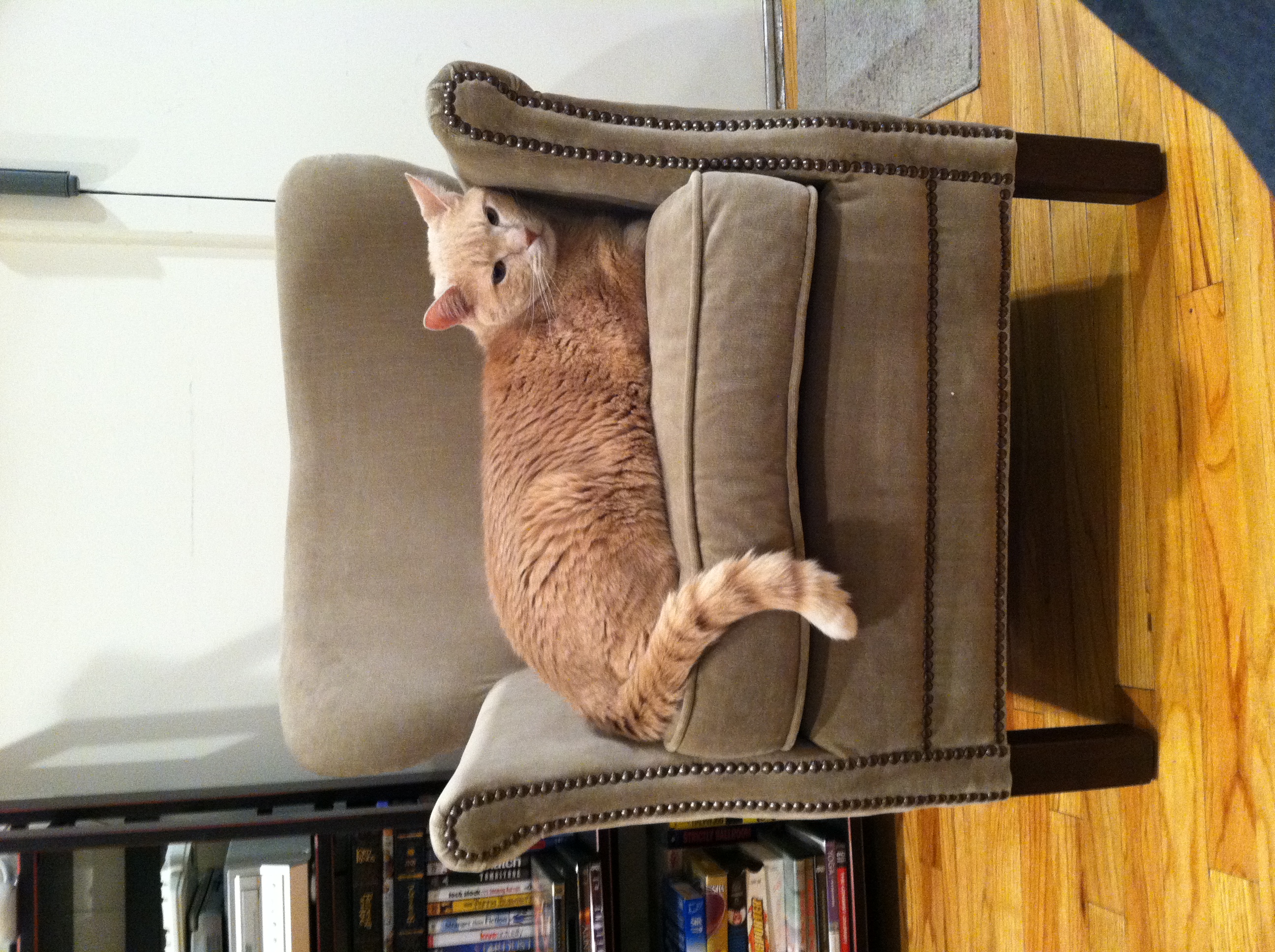
Keeping me company: since we got two new chairs for the living room, Mr. Ramses has been utterly useless (shocking, I realize).  He just lolls about in them all day like a Roman Emperor waiting to be entertained with wine and bloodshed.

Out the window: early summer has slipped up on us here in Brooklyn.  This might sound like a good thing…unless you rely on window A/C units to keep your workspace cool. Ugh. I now remember why I spent so much time working in cafes last summer…

In my mug: I’m embarrassed by how much tea I’ve been drinking, I really am.  Let’s just say, I got three boxes of Numi’s Aged Earl Grey what seems like just days ago.  Two bags remain.

A little procrastination never hurt anyone:  who am I kidding?  Of course it does.  The internet has been my enemy lately, tempting me away from my work with a never-ceasing death-spiral of links to follow, and follow, and follow.  I can’t bring myself to contribute to your destruction as well.  Pop into the comments to tell me about your current writing projects, then go work on them!

Book Review: In the Garden of Iden

In the Garden of Iden by Kage Baker (1997, 329 pages, Science/Historical Fiction)

Well, I must say, this book was not at all what I was expecting.  The cover and blurb on the back imply time-traveling science fiction with immortal cyborgs.  The story delivers that, plus a Jane Austen-esque romance married to a Charlotte Bronte-esque tragedy mingled with a heavy dose of philosophizing on religion and the human condition.  It was the strangest, loveliest mash-up; wholly unexpected and very hard to set aside.

The story follows Mendoza, a child plucked from the clutches of the Spanish Inquisition by the Company, a group of immortals bent on saving the world’s treasures from the rest of us “ugly monkeys.”  We follow her adventures as she too is transformed and then plopped down in rainy, tumultuous sixteenth century England to complete her first Company assignment.  Though iced over with a veneer of Sci Fi, this story boils down to a romance – part Darcy and Elizabeth’s delicious verbal fencing and part steamy bodice-ripper, all shadowed over with the looming efforts of doomed Mary Tudor to re-Catholicize England.

Such a crazy combination of styles and stories would result in an awkward narrative in less skillful hands, but Kage Baker fits it all together like a Rubik’s cube and hands it to you with an unsettling smile.

Blast from the (not so distant) past

Dear Readers,

It is officially the 202 day anniversary of my blog.  Happy randomly selected day of celebration to me!

In honor of this auspicious event, I’ve decided to put up links to my personal favorite posts since the blog’s inception.  Those of you who are newer readers can delight in posts you missed out on the first time around and faithful readers from Day 1 can wander down that beloved path known as Memory Lane.  It’ll be fun, I promise!

Soooo, without further ado and in no particular order, here are my 5 favorite posts from the last 202 days:

1. A golden oldie from my first month blogging, in which I ponder the age old writer’s dilemma between experience and imagination.  What’s the right balance, especially when writing speculative fiction?

2. My first ever post, a discussion of the role of realism in fantasy writing.  How much gritty, true-to-life detail do we want in our fiction?  Do we prefer George R.R. Martin’s misery, blood, and betrayal or would we rather hang out with Tolkein’s noble heroes and misty elves?

3. My reflections on the handicaps (and advantages) of writing fiction when you come from an academic background.  The post title says it all (sort of): the curse of academia.

4. My musings on the pleasures to be had in re-reading old favorites.  I know why I love to do this.  Why do you?

5. Finally, here’s one from a few months ago that generated rather a lot of comments and discussion:  how we respond to critiques of our writing.

Enjoy, and feel free to share links to your favorite posts from your own blogs (or, hell, share ones from the blogs of total strangers!) in the comments.

And, because you can never say it enough, many thanks to YOU for making me feel like I’m not just flinging my thoughts out into a dark and empty void.  I love you all.

Nebula award winners

SFWA has their announcement up for the Nebula award winners following this weekend’s ceremony.  Here’s the link.  Though I had my fingers crossed for Jemisin’s Hundred Thousand Kingdoms (one of my favorite reads in recent memory), Connie Willis (the novel winner with Blackout/All Clear) is pretty darn awesome too.  Congrats to the winners, as well as all those nominated!

Juggling

Most days I like to think I’m pretty damn good at keeping all my juggler’s balls in the air.  Home life.  Work life.  Writing life.  Social life.  Most writers, even successfully published ones, have day jobs they must structure their writing around.  Many of us have families.  All of us have unexpected joys and tragedies to deal with.  It’s part of life.

Those of us who’ve decided to make our writing a priority have devised ways to work it into to our daily lives, carving out spaces and times that we try to keep inviolate.  For some it’s a set time each morning or night, hewed from the dark hours before or after kids and spouses and pets and chores and day jobs claim our attention.  For others it’s a set word count for each day or week, or an office no one else can enter while we’re working, or a cafe we can slip away to.  In the usual ebb and flow of life, these strategies tend to work.

But what about when the unexpected happens?  A baby enters your life.  Someone close to you dies.  You get bad news about your health.  You move houses, or jobs, or spouses.

What do you do when the Big Life Decisions intervene, when that carefully constructed scaffolding gets bumped and comes tumbling down in a shower of ill-fitting pipes and jagged-edged 2x4s?  How do you keep up with your writing then?

Finding the time to write isn’t the only problem here.  So is focus, creativity, and space to think.  When you’re consumed by important things happening in your life (good or bad), how do you summon the mental discipline to focus on fictional worlds and characters, on the struggles of people you’ve given creative life to, but who – quite frankly – will still be there when your personal situation settles down?  Sometimes I can channel whatever is consuming me personally into my writing, other times all I do is hit a wall my mind flatly refuses to find a door through.

I don’t have answers here, just questions.  But I’d be willing to bet nearly every writer I know has faced these same problems at one time or another.  If anyone has insights or advice to share, I sure would welcome them!

And now…I’m off to use my mind lasers to cut a way through this damn wall and WRITE.

Book Review: Native Star

Native Star by M.K. Hobson (Fantasy/Steampunk, 2010, 387 pages)

Native Star recounts the adventures of Emily Edwards, a witch from a backwater, wild west town.  Headstrong and opinionated–yet still rather naive–Emily is swept off on a cross-country quest when she inadvertently bonds with an unstable chunk of magical stone (the titular native star).  Joined by snobby, uptight warlock, Dreadnought Stanton (no, I’m not making that up), she finds herself racing against time and a host of devious bad guys who want nothing more than to get their hands on the stone–whether or not it’s still embedded in Emily’s hand.  There’s plenty of high stakes action, romance, and magic to keep the reader well entertained.

I was impressed with the way Hobson unfolded the plot of Native Star.  In particular, the author does a great job of pacing and upping the stakes throughout the story.  Each time you feel you have a handle on what Emily and Dreadnought will do to save themselves, Hobson changes the stakes and moves the plot in a believable but not wholly expected direction.  This kept my interest and made it hard to put the book down.  The character development is also fairly well done.  Emily and Dreadnought both have likable and unlikable qualities and both grow and change in ways that are consistent with their backgrounds and the things they experience during their journey.

A few small nits are worth mentioning – first, the novel really only has minor streampunk elements (most notably a pretty darn cool biomechanical flying machine), but aside from a prosaic steam engine train, these elements are largely unnecessary to the plot; the story could have been told just as well without them.  There are also moments where the narration style vacillates unexpectedly.  For much of the story I felt I wasn’t meant to take anything too seriously — it was all just a fun romp.  Then an odd, deeply serious mood would fall over certain passages and I felt I had wandered into a wholly different story.  This isn’t really a bad thing, but I did find it a bit jarring.

In sum, though, Native Star is a fast, fun read with interesting characters and a cool setting (I’ve always been a sucker for early American history).  The story is a stand-alone with a proper well-wrapped-up ending, but it does seem to leave the door open for a sequel.

Anyone else read this one?  Thoughts?

Writer’s Workspace: 5/10

Good morning!  Welcome to this writer’s workspace.  Here’s what’s happening liiiiiiiiiiiiiive at Miranda’s desk:

What I’m working on: my little fingers are tap-tap-tapping as I labor to increase my word count on the first draft of ABSENT, my time-travel novel (currently at about 38,000 words).  In today’s installment, our intrepid heroine visits the 1920’s excavations at Ur, Iraq for the first time.

Snippet from the screen:Emily stood at the edge of the great excavation trench and shielded her eyes from the sun.  The ziggurat towered to the east, casting a long shadow behind them.  Beyond, mid-afternoon light lanced across the desert, bleaching color and washing everything to a faded, dusty taupe.  Iraqis draped in robes and headscarves labored in the trench, shoveling, lugging dirt, and calling out to one another.  The edges of an ancient mortar wall were beginning to emerge from the chaos of sand, picks, and men.”

In my mug: this morning I’m guzzling down multiple mugfuls of an organic Indian Darjeeling handpicked by virgins, flown to the States on the wings of cherubim, and sold in bulk by the faux-hippies at the Park Slope Food Co-op (okay, only the last part of that is true).  As my 2 1/2 year old niece Lyla would say: “it’s nummy, Aunty Mimi!”

Keeping me company:  everyone’s favorite fuzz-monster is is trying to seduce me away from my work with his most winsome and plaintive expression.  Devious, he is, but I will not weaken.

On the iTunes:  Tiny Dancer by Elton John.

Out the window:  we are finally, finally, finally getting some gorgeous spring weather here in Brooklyn.  It’s sunny and 65.  Marvel, dear Reader, at my willpower as I resist the urge to wander away from my computer and eat ice cream in the park.

A little procrastination never hurt anyone: first off, go check out fellow VP alum Nicky Drayden’s new short story collections.  Aptly titled “Delightfully Twisted Tales,” the collections showcase her sharp, witty prose.  Over at TalktoYoUniverse there’s an interesting post on re-envisioning a scene without totally rewriting it, mostly by focusing how your characters respond to each other and feel about the unfolding action.  Finally, in conjunction with the announcement of her first published story, “Luck be a Lady”, Amy Sundberg blogs about the role of luck in our lives.

In closing today, I ask not only what YOU are doing this fine morning, but also request you share any wonderful procrastinatory links you might have up your sleeves (favorite blogs, cool videos, new publications you want to pimp…) – come on, what corners of the internet do you like to hide in?  Tell all.