Here I am. What do you think?

Since getting serious about writing fiction a little over two years ago I’ve noticed an interesting phenomenon:  writers seem to form social bonds with each other very rapidly.  There is a lot of rhetoric in the writing community about “finding your tribe”, which is–I suppose–meant to imply the discovery of an alchemical union among those of like minds who color outside the normal lines of society.  I’ve always found the idea oddly cultish, but like so many things that worm their way into common vernacular, I’ve realized there is something to it.

Last weekend I attended a writing retreat in Dallas.  It was lunchtime on the second day and a bunch of us were sitting around at Chipotle, just hanging out.  It struck me that two years ago I knew none of these people, some I’d literally only met the day before, and even those I’d known longer I saw at most once a year or only online.  And yet I exposed my vulnerable insides to them on a regular basis and trusted them not to eviscerate me (or, to know if they did it was out of love).  Munching my tacos and pondering this, I though: “this is freaking amazing.”  And it really is.

When I attended the Viable Paradise workshop in the Fall of 2009 I didn’t know any other writers.  Because of the friendships I forged in that one short week on Martha’s Vineyard, today I am part of vibrant community of writers, many of whom I feel as close to as friends I’ve known for years.  How can this happen in such a short time and on such short acquaintance?  It sounds crazy.

It boils down, I believe, to the basic fact that sharing your writing and giving and receiving critiques is deeply, unavoidably personal.  It cuts right through the delicate dance of “how much of myself should I show these people” that we usually engage in when we make new friends.  You basically walk up to another writer (who may come from a different part of the country, have different political or religious views and a wholly divergent background from you) open up your chest, pull out your heart and say: “Here I am. What do you think?”  You’ve found your tribe when they don’t run screaming.

All of this leads you to come to trust people whose lives you may know very little about or with whom you do not interact much beyond your shared love of writing and desire to improve that writing.  It’s a broadening, life-expanding experience.  As an anthropologist, I admit I find this fascinating.  In some ways, the little tribes we writers form are nothing at all like real tribes, which are rooted in kinship.  On the other hand, if we consider this term more broadly, writer’s tribes are totally rooted in kinship, just not the biological kind.

So, sitting there in the Dallas Chipotle, looking around at a circle of friends I acquired by most unconventional means and cherished all the more highly for it, I felt profoundly grateful.  We may not see each other in person very often and our honesty with each other may sometimes bruise egos or rub up against prickly edges, but I wouldn’t have it any other way.

Controlled chaos

It’s been a hectic couple of weeks around Casa Suri, and no mistake.  I’m pretty sure the last time I sustained this level of continuous stress was back when we were planning our (2) weddings.  Nevertheless, life must go on.  Exams must be written, proctored, and graded.  Words must be written.  The garbage insists on being taken out.

Major amounts of traveling are not helping things.  In the next seven days my husband will journey to states that touch all four borders of our country to give talks and go to interviews.  This makes me feel quite lazy to be traveling to only one place: a writing retreat in Dallas.

Though it’s adding to the pig pile of stress, the retreat also promises a much-anticipated break from it.  It’ll be populated by some good friends as well as new faces.  As hard as it’s been to carve out time to critique all the submissions, it will — I know — be well worth it.  I’m hoping for camaraderie, inspiration, good food, and plenty of beer.

Hopefully they’ll be time for the occasional update while I’m away…so stay tuned!

Everybody says…

…that chocolate is the best cure for the blues.  Everybody knows, though, that the real answer is exercise.  I woke up in a remarkably black mood this morning, so I’m trying both.  I flung myself around on the treadmill at the YMCA until I was too tired to maintain a crabby attitude.  Now I’m sitting at my favorite neighborhood cafe with a steamy, frothy mug of hot chocolate.  The special alchemy of endorphins + chocolate + Friday seems to be working.

So, on to some writerly updates.

I’ve punched out about 7K this week on the second draft of my archaeological time travel novel ABSENT.  For me, this is heavy-duty progress and I feel about 80% confident I can make my self-imposed deadline of April 1st to finish the damn thing and send it off to my writing group.

I submitted a few short stories that had been on the back burner to various markets, which felt good.  I’ve really stopped writing short fiction lately (the two novels I’m cooking up are more than enough to be getting on with), but it’s nice to have the shorter-term gratification that comes with knowing you’ve got a few things out to market.

The other big project on the docket is plowing through approximately 80K of submissions for the writer’s retreat I’m attending in Dallas at the end of next week.  I’ve skimmed over almost everything and started in on a more thorough read-through of two of the subs.  There’s a wide range of material and it’s nice to get out of my own head for awhile and see what other people have been working on.  Still, it is a lot of words, so I’d better get serious…and soon.

In non-writerly news, “the upheaval” continues (and will no doubt do so for quite a while).  My attitude on the whole thing changes with the wind, but right now I’m hopeful some hail Mary passes sprinkled liberally with fairy dust may bring the whole situation to a happy conclusion.  More to follow.

On a more cheerful note, our downstairs neighbors finally moved in yesterday. We are no longer the sole occupants of the 4 unit Brownstone in which we live!  The new neighbors seem nice — charming even.  They appear to have sufficient fingers and toes about them and no sign of horns.  All in all, a very positive development.

Well, there’s lots of reading and writing to be done and my hot chocolate is getting cold.  If you feel so inclined, please share your recent writing goals, accomplishments, and plans in the comments.  It’s always nice to know what everyone else is up to — makes you feel less alone, you know?

The Upheaval

I haven’t posted in awhile because I’m not sure what to say.  Something unexpected has happened.  Let’s call it “the upheaval”.

On the surface, “the upheaval” is Not Good.  Beneath the surface it may reveal itself to be a positive change or a neutral one, or just different.  It’s too soon to say.  In the meantime, it is unsettling and stressful and feels not quite real.

What has happened is not, in of itself, the point.  The point is that it feels weird and trite to be posting writing updates and book reviews as if everything is normal —  which is a stupid reaction because, of course, life goes on even when bad (or positive-disguised-as-bad, or neutral, or different) things are happening.  My dad would probably remind me that, in fact, those things *are* life.

I don’t like to whinge about my problems, mostly because I feel that my problems usually don’t warrant the title.  I’ve lived with Honduran families in houses with no electricity and a dirt floor who considered themselves very lucky compared to their neighbors down the street in the house made out of cardboard boxes.  Viewed in that light, it feels pretty unseemly to complain about the disappointing things that happen from time to time in my otherwise-charmed life.

So, I’m not writing this entry to complain but to share a happy discovery that has emerged from this week’s special brand of bleck:  writing is a really good way to get through a hard time.

Escaping into the imagined worlds of the novels I’m writing has proven an excellent cure for getting through a situation I can’t personally do much to effect (cupcakes, hot cocoa, and ice cream also appear to be viable treatments). In fact, during “the upheaval”, I’ve gotten more writing done than I have in months.  Even now, when things seem a little bleak, its nice to find that writing isn’t just something I love to do but something I can take solace in as well.  That’s pretty cool.

Maybe “the upheaval” can even be seen as an inciting incident, the start of a new story.  I certainly hope so.

In the meantime, pass the cupcakes.

Food for Thought: World’s Best Lasagna

Yes, seriously.  This recipe produces the world’s best lasagna.  Try it.  I dare you. 

Okay.  It’s a sleepy Saturday and you’ve got a dilemma.  There’s writing to get done, but you’ve also got people coming over for dinner.  This is the perfect dish to prepare because it allows time to write (about an hour and a half while the ragu is reducing to a melty puddle of animal goodness) and results in a soul satisfying meal.

This recipe is loosely adapted from Mario Batali’s cookbook “Molto Italiano” and is in the style of a Lasagna al Forno.

Serves 6. Total cooking time about 2 1/2 – 3 hours (but worth every second, I swear!).

Ingredients
For the ragu
1 lb of Italian sausage, removed from the casting
4 oz of pancetta, finely diced
1/2 lbs of ground beef
1 medium yellow onion, diced
1 large rib of celery, finely diced
1 carrot, finely diced
4 cloves of garlic, finely diced
1/2 cup of tomato paste
12 oz of diced tomatoes in their juices
1/2 cup of whole milk
1/2 cup of water (or white wine)
1 tsp of fresh thyme
Olive oil
Salt & pepper

To make the ragu: pour about 1 Tbs olive oil in a large pot and heat on medium high. Add the diced onion, celery, carrot, and garlic and saute until translucent but not brown (about 5 minutes). Increase heat to high. Add the sausage, pancetta, and ground beef. Stir and break up clumps with your spoon until the meat is browned. Add the tomato paste, diced tomatoes, water (or wine), and milk. Stir well to incorporate. Add the thyme. Bring the mixture to a low boil and then cover and reduce heat. Let the ragu simmer, stirring occasionally, for about an hour and a half. Taste the sauce and adjust the seasonings by adding salt and pepper as needed.

While the ragu cooks, sneak to your office and get some writing done!

For the bechamel sauce
5 Tbs of butter
1/4 cup of flour
3 cups of whole milk (2% may be substituted, but do not use skim)
grated nutmeg & salt to taste
2 Tbs of mascarpone cheese

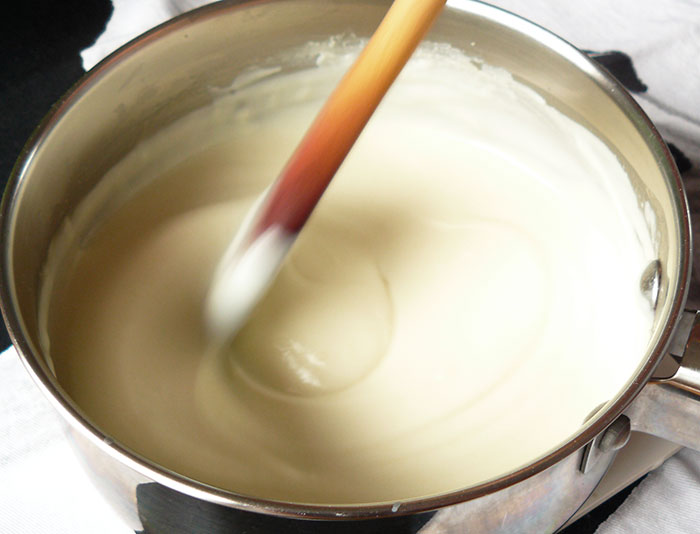
To make the bechamel: in a clean pot, melt the butter and wait until it bubbles/sizzles slightly. Add the flour and stir while it bubbles and sizzles to cook the roux. Add the milk, whisking vigorously to prevent lumps from forming. Cook the mixture over medium to medium-high heat until the sauce thickens and bubbles. Add grated nutmeg and salt to taste. Whisk in the mascarpone.

For the noodles
1 package of dried Lasagna noodles
fresh parmigiano reggiano cheese (do NOT substitute pre-grated cheese!!!).

To cook the noodles: bring a large pot of salted water to a boil. Cook 4 lasagna noodles at a time, about 4 minutes each to par-cook.

To assemble the lasagna: layer the ragu, noodles, bechamel, and freshly grated parmigiano reggiano in a large, oven-safe casserole dish. Begin with a thin layer of ragu (enough to just cover the bottom of the dish). Layer noodles (one noodle thick) atop the ragu. Add another layer of ragu (a good, thick portion so that the noodles no longer show through.) Atop the ragu, add a layer of bechamel sauce. Atop the bechamel, add a layer of freshly grated parmigiano reggiano and a sprinkle of sea salt. Repeat this process until the dish is nearly full. Be sure not to skimp on the layers of ragu and bechamel; the idea is to create a thick, gooey layer between each noodle. You should wind up with only about 3 layers of noodles. The final, top layer should be bechamel sauce with plenty of parmigiano grated atop it and sprinkled with sea salt.

Place the lasagna into a preheated 375 degree oven and cook until the dish is bubbling and the cheese on top is beginning to brown (about 45 minutes). Any exposed pasta edges should be crisp. After removing from the oven, let the lasagna rest about 10 minutes (if you can bear it). Serve with wine (to cut the richness) and a simple salad.

Bon appetit!

Writer’s Workspace: 2/29

Good morning!  It’s Leap Day!

Welcome to this writer’s workspace.  Here’s what’s happening liiiiiiiiiiiiiive at Miranda’s desk:

What I’m working on: Today I’m putting the finishing touches on the first three chapters of my newest novel, a secret project involving viruses, magic, and murder.  This 8k sample will be my submission for a writing workshop I’m attending in Dallas in March.  Here’s a sneak peak from Chapter One:

Snippet from the screen:  Aaron Rooney’s eyes bulged with dislike.  “You keep your mouth shut, you little freak, or I’ll have you up on charges.”

I was getting all ready to snarl back when Daniel settled his hand on my leg.  Time was I would have opened my veins right there, bathed the pickup with my blood, persuaded it to turn into a monster, and sent it chasing Sherriff Aaron Rooney all the way down to the Port Townsend ferry.  But that was before I’d met Daniel.  I took a deep breath.  

“Apologies, Sherriff.”  I tried to smile winsomely.  Problem was, I hadn’t felt winsome in about three years.

In my mug: It’s an English Breakfast type of morning, so naturally I’ve got a cold mug of green tea with honey.  Sigh.

On the iTunes: my playlist this morning features an eclectic mix of moody tunes.  Right now Solomon Burke is crooning “Cry to Me”; next up, “Losing my Religion” as sung by Dia Frampton.

Keeping me company: His Royal Highness, Sir Ramses the Displeased, has parked his majestic behind on my desk.  He insists on sitting on top of my mouse pad and mouse and biting me every time I attempt to dislodge him.  Please send help.

A little procrastination never hurt anyone: an interesting read here, from Jody Hedlund’s blog, on the importance of story over perfection, the latest podcast from Writing Excuses, and three pudding recipes that are sure to make you fat (and happy).

How are YOU taking advantage of our temporal bonus this year?  What’s on tap for your Leap Day?

Dollshouse Downton

As any of you who follow me on Facebook are likely aware, I’m obsessed with the cleverly written, beautifully produced soapy delights of Masterpiece’s Downton Abbey.  Sadly, Series Two just finished airing here in the US and we have to wait a WHOLE YEAR for more on the upstairs/downstairs drama of our favorite Brits.

But, there are consolations to help us keep a stiff upper lip during the long wait, including this delicious dollshouse version the show.  I’ve embedded the first episode here, but you can see them all on good ole YouTube.  May I just say that I love that William is a penguin and O’Brien a weasel 🙂

Book Review: The Drowning City

The Drowning City by Amanda Downum (2009. 384 pages. Fantasy)

Tired of fantasy novels that all strike the same culture notes, revolve around a (male) chosen one and his quest, and stretch laboriously across book after book?  If so, I recommend you check out Amanda Downum’s The Drowning City.

A delicious blend of cultural influences from across south Asia, the story is set in the titular drowning city, Symir.  Symir is a lush place — humid, veined with canals, and thrumming with violence and intrigue — and it is to this city that necromancer and spy Isyllt Iskaldur is sent by her masters to stir up rebellion.

Though Downum does a great job of making the world her story is set in feel like a vast, diverse, and sprawling place, and though she alludes to larger schemes at work, they all lie beyond the scope of the novel itself.  This is an epic fantasy in tone, but it’s set in just one place with just one story; it is self-contained and absorbing.

As Isyllt goes about her work of inciting revolution, she encounters a secretive fire mage, an out-of-her-depth would-be revolutionary, and a displaced, genocide-ravaged jungle people who’s ghosts won’t lie quiet.  The intrigues Isyllt uncovers and encourages soon prove far more dangerous than she imagined and the world of Symir positively steams with magic of all possible stripes and persuasions.

Isyllt herself is an unusual heroine — definitely one of the “dark and troubled” ilk.  As a necromancer, her magic is literally the power of death, and she wields it in interesting ways (no spoilers here, though, I promise!).  Prickly, brooding, and thrill-seeking, Isyllt is the kind of woman to plunge headlong into danger, which makes for plenty of thrilling action.

Some may find her character unlikable and her apparent death wish unsettling, but her ruthless, ends-justify-the-means exterior is just that, her exterior.  In Isyllt, Downum has created a very textured character, and one I found a fascinating guide through the story (though her point of view is not the only one relied upon in the narrative).

A final comment:  despite it’s fantastical nature, the Drowning City and it’s inhabitants feel incredibly real; Downum has grounded her tale in believable emotions and motivations.  The betrayals, sacrifices, and triumphs come twisting at you unexpectedly while still managing to seem inevitable (at least in hindsight).  Best of all, if you find this book as satisfying as I did, there are two others (both stand-alone novels featuring Isyllt) to come: The Bone Palace and The Kingdoms of Dust.

Happy reading!

The Magic of Place

I was listening to a recent Writing Excuses podcast discussing the city as a character and special guest Sarah Pinborough made an off-hand remark that set me to pondering the connection between place and magic.

She mentioned that London’s gritty and historical character made it a city particularly easy to imagine as magical.  Though it has a far shorter historical resume than London, I’ve always felt the same was true of New York City.  Where does that dark, garbage-strewn alley lead?  To a magical land?  To hell?  Could the stall at the end of the row in the bathroom at the New York Public Library be a portal to another world?  Surely there are fairies living in the Shakespeare Garden in Central Park?  Surely there are.

Not only the history of the place, the sense that it’s current incarnation is built on the bones of something older and darker and different, but also it’s mood of danger, excitement, and anonymity, lend New York an air of believable mystery, of magic.

Is this true of every place, though?  Is Newark, NJ a magical city?  Could we set a convincing urban fantasy tale in Miami or Dallas, or would New Orleans be better?  Is there something about the run-down, dilapidated corners of older places that make them better suited as magical settings, or can new, shiny cities provide inspiration too?

Another question: what about urban versus rural?  The countryside is magical, isn’t?  We can picture magic lurking in the dark, cool depths of an old growth forest and sparking in the bright, sunny charm of the pastoral world, with it’s crooked fences and falling-down stiles.  But what about in the manicured limits of a suburban park?  Does the vast swath of strip mall America provide a good setting for a magical story?  Will we find Selkies bathing by moonlight among the concrete fountains of open-air malls or a coven of witches dancing beneath the glow of parking lot lights?

When we devise settings for our stories, how important is location?  To what extent does the place we choose influence the flavor and believability of the magic woven into the narrative?  Can any place be magical?  Does taking a seemingly unlikely place for magic and making it work lend your story a freshness that setting it somewhere more obvious might not have achieved?

I like to think New York is a magical place, but maybe that’s because I live here and I love the city.  Perhaps we all feel that way about places we love – be they Savannah, GA or Palo Alto, CA.

What do you think?

Can we make magic anywhere, or are some places better-suited to telling magical tales?  Share your thoughts in comments!

Nebula Nominations

SFWA has announced the Nebula nominees for 2011 — and not only are some of my recent favorite books and stories on the list, but also some of my friends!

First, a huge shout-out to Ferrett Steinmetz, a fellow Viable Paradise (VP) alum and member of one of my writing groups, for his novelette Sauerkraut Station.  Another VP alum, Jake Kerr is nominated for his novelette, The Old Equations, and fellow Superstar Writing Seminar alum Brad Torgerson is up for his novelette, Ray of Light.

I was also excited to see Daughter of Smoke and Bone (by Laini Taylor) nominated for best YA novel; I just finished this one a few weeks ago and looooved it (review to come soon), as well as the always-awesome Mary Robinette Kowal for her novella, Kiss Me Twice, and N.K. Jemisin for her novel The Kingdom of Gods.

A HUGE congrats to all the nominees!