Archaeological inspiration

The Nabonidus phase Ziggurat in the late 1920's

As I bring revisions on draft #2 of ABSENT to a close, I’ve taken a brief commercial break to revisit my research.

The final third of the novel is set amidst the 1920’s-era excavations at the archaeological site of Ur, Iraq, and as much as my story is about magic and time travel (and adventure! and romance!), I want it grounded in real details.  I want it to feel authentic.

Reading through the first draft, one thing that struck me was how generic this portion of the novel felt.  Sure, I’m an archaeologist and I should be able to bring an archaeological expedition to life in prose, but I work in Central America — literally a world away from Mesopotamia.  Plus, I work in the 21st century, not 1925.  I realized drawing on my personal experiences wasn’t going to be enough; I needed to go to the source to understand what the Ur Expedition was like.

So, I spent the last four days pouring over the Ur Expedition Reports, a series of manuscripts penned by Sir Leonard Woolley to present his interpretation of two decades of archaeological research.  And quite a productive few days it has been.

The way archaeological work was conducted in the early part of the 20th century was so different from how we work now. 

Woolley employed an army of Iraqis to literally peel away millions of tons of soil and expose huge swaths of the ancient city, plowing down through jumbled historical and prehistoric time periods in various parts of the site, including the ziggurat, terrace, cemetery, and surrounding city.  The man excavated with a zeal that would be completely unsustainable (and un-fundable) today.

My goal in reading up on the excavations wasn’t just to get the specific terminology and time periods of Sumerian archaeology down, but also to find a part of the site for a particular artifact (invented and important to the plot) to be discovered.  It needed to come from a part of Ur that would make sense for the artifact (it being religious & political in nature), as well as one under excavation while my characters are there (late 1925-early 1926).  I combed through the reports and finally found the perfect spot, a part of the Court of Nannar excavated more or less within my time frame.

The spot in question is a sunken room sealed with bricks and buried beneath a destroyed building inside the court.  Woolley describes it as a possible gigunus (translated as “the dark dwelling” or “the place which should not be looked upon”) — the perfect spot for a dangerous object to have been hidden away.

Woolley’s reports were also surprisingly useful for capturing the mood of the setting.  The story takes place in the winter, apparently an unlovely time of year out at the site.

Woolley writes, “It is a melancholy prospect. The flat horizon is broken by a long ridge of wind-blown sand which emphasizes rather than relieves the desolation. All is desert now. A featureless expanse of grey mud and yellow sand.  During the ‘blue month’ of late December and early January the wind blowing out of the northwest desert brings so piercing a cold that the water in our clay drinking-jars is frozen solid.” [Ur Excavations, Vol ii, p. 2]

Wordy, maybe, but evocative.
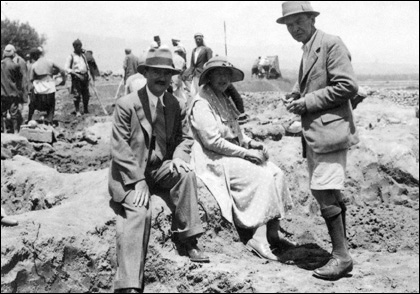
Agatha Christie at Ur, 1930's. With Max (on left) and Sir Leonard Woolley (on right)

For hints as to what life was like on the dig and around the expedition house, fate has lent me an additional boon.  The late, great Agatha Christie herself visited the Ur expedition in the 1930’s.  She not only spent some time there (and met her future husband, Max Mallowan) but she also set one of her novels, Murder in Mesopotamia, in the expedition house.  The novel is full of lovely details, including a map of the layout of the expedition house and plenty of descriptions penned by someone who’d spent time there.

Between the Expedition Reports, Agatha Christie’s novel, a treasure trove of old photographs found online (like those included in this post), and my own not-infertile imagination, the generic planes of the final third of ABSENT are starting to pop up into something resembling a real place full of real people.

Yay, research!

Now, to finish the damn thing.

*cracks knuckles*

Regime Change

In my opinion, to be a happy and productive writer, one must also be healthy.  Despite my insatiable love of food (see yesterday’s blog post), I’ve always striven to be as healthy as a I can.  In some regards, I do quite well.  I eat almost no processed foods or beverages and I cook most of our food from raw, whole, organic products.  In other areas, I miss the mark by a mile.  My favorite foods are full of fat — cheese, butter, cream, cured meats.  And then there’s the whole exercise side of the equation.

I hate to exercise, and when it comes to things I don’t enjoy I can be one big lazy fool.  Motivation is a major issue and I’ll latch on to any excuse to avoid exercising.  When I was younger, my metabolism was awesome and I could get away with this.  Not so anymore.  I’ve gained 10lbs in each of the last two years.  While I might be starting with the advantage of being slim, that won’t be the case much longer.  Extrapolate out 10lbs of weight gain a year for a few more years…a troubling and unhealthy trend by any measure.

So, regime change time. I have to start exercising and eating more moderately (let’s just say that little trip to France didn’t help matters).

Enter another problem: I am a woman of extremes.  I’m always either boiling hot or freezing cold, starving to death or so full I’m gonna throw up, bursting with energy or so tired I JUST CAN’T GO ON.  This little character flaw extends to every exercise and weight loss endeavor I’ve attempted.  Usually I wake up one morning and announce I’m going to get fit and lose weight.  I rush to the gym, totally overdo it for about a week, and starve myself on a calorie restriction diet.  This results, as you might imagine, in injury or physical collapse.  The outcome:  I stop exercising.

Time to learn the art of moderation.

I resolve to exercise and eat moderately with the goal of gradually, rationally losing 10lbs by the end of the summer.  Since I’m big on accountability (it’s the only way to avoid the “any excuse to stop” mentality), I’ll use a few tools to help me stay on track.

First, with regard to food, I’ll keep track of my calories on fitday.com.  This site is free and provides a number of handy pages for counting calories, entering activity (calories burned), and tracking progress.  It informs me I’ll need to keep my caloric intake under 1800 calories a day to meet my goal by August 31 (either through calorie restriction, calorie burning, or a combo).

Second, I’ll reinstate a tool that’s helped me in the past: Miranda’s Chart of Shame.  This is a simple excel spreadsheet I worked up that displays each day of the week with the type and amount of exercise I should do that day.  If I do it, I get to cross it off.  If not, I have to write SHAME in bright, huge, block letters on the day in question.  The chart is printed and displayed on the front door of the apartment, for me to look at every time I come and go.  It’ll be there, JUDGING ME, every minute of every day. For the first month, I’m going to start gradually with 3 days a week of cardio, 1 of weightlifting, and 5 of stretching and exercises for my back (from an injury sustained the last time I tried to exercise regularly).  After a month, I’ll reassess based on my progress.

Third, I’ll post my progress here on the blog — the good, the bad, and the ugly.  At the end of each week, as part of a general weekly update, I’ll include whether I met my exercise and dieting goals for the week or not.

I’m hopeful this system will work.  It is a good time of year to start adopting better habits, after all.  Nicer weather makes it more enticing to go out and exercise, and all that colorful spring produce makes it easier to eat right.  So, wish me luck, guys…and if you want to join in my crusade to get healthy, let me know!

Food for Thought: Lemon Tart

It’s a rainy spring Sunday and I’ve decided there’s no better way to embrace my inner-sunshine than to bake a simple, gorgeous lemon tart.

The work involved is minimal for such a sumptuous and impressive desert.  Best of all, you can fill the hour or so you’ll need to wait before eating the tart with some writing time.

The tart recipe I offer here is one I learned at a cooking class in Nice, France.  It riffs on a traditional lemon tart by adding local olive oil to both the crust and filling (Nice olives produce a light, mild oil that pairs well with the tart lemons).  While this may sound strange, it only imparts the faintest essence of olive oil to the taste and gives the crust a cookie-quality and the filling a silkiness that’s the stuff of dreams.  Trust me 🙂

Lemon Tart with Olive Oil (serves 4)

First, you need to make a pastry crust.  This sounds intimidating, but the crust here is very resilient and hard to mess up.  Start by cutting 1/4 cup of cold unsalted butter into pieces.  Place them in a bowl and sift 1/4 cup powdered confectioners sugar over them.  Add 1 1/2 TBS of finely ground macadamia nuts (or almonds, if you prefer).  You can pulverize the nuts in a baggie with a mallet, or use a nut/spice grinder.  To this, add 1/4 tsp sea salt and sift in 2 TBS of flour (you’ll need 3/4 cup flour in total, so measure out the full amount and then sift in just 2 TBS of it).

Work this mixture with a pastry paddle, a spoon, or your fingers.  The goal is to get the dry ingredients well integrated into the butter.  Don’t worry if it looks a mess.  Once it’s mixed, sift the rest of the flour in and add 1 egg yolk (separate and discard the white) and 3 1/2 TBS olive oil (if you can’t get an AOC Nice oil, select something light and mild).  Mix this all together with a fork.  It’ll be quite wet.  You may even want to put the bowl in the fridge for 10 minutes or so to stiffen the dough up before you work it into the tart pan.

Plop that dough out into the tart pan (you’ll need a 9 1/2 inch one with a removable bottom) and, using your fingers, work it until it thinly covers the entire bottom and sides.  You want this to be thin – such that you can almost see the tart pan through the dough.  Pay special attention to the corners.  The dough on the sides will sink slightly while the tart bakes, so make sure you get the corners extra thin to start.  If the dough gets too soft to work with, just toss the whole thing in the fridge a few minutes to firm it up.  Scrap the excess dough off and discard.

Bake the tart shell in the oven at 425 degrees for about 10 minutes.  Watch it carefully near the end so it doesn’t burn.  You want a nice, golden brown color.  Set the shell aside to cool while you prepare the filling.

For the filling, begin with 3 plump lemons.  Roll them on the counter before you juice them (this helps release the goodness within).  Squeeze the juice into a bowl, discarding any seeds.  Before cutting and juicing the final lemon, use a microplane grater to zest 1 lemon.  You can add the zest right into the bowl with the juice.

In a small pot, crack 2 whole eggs and 2 egg yolks (separated from the whites; whites discarded).  Whisk these together with 3/4 cup of granulated sugar.  Whisk in the lemon juice and lemon zest and sift 2 tsp of cornstarch over the mixture.  Whisk the entire mixture over medium low heat until it thickens.  The idea is to keep whisking constantly so the lemon curd aerates.  Once the mixture is fairly thick, remove it from the heat and whisk in 4 TBS of unsalted butter.  Then whisk in 2 TBS olive oil, the same type you used for the crust.

Pour this mixture into the cooled tart shell and put in the fridge for at least an hour to set and cool.  Rather than drive yourself crazy waiting to cut into the tart and devour it whole, take this time to sit down and write.  The tart, after all, will be your reward for a good word count 🙂

After you’ve achieved at least a couple hundred words, or can wait no longer, whip a little lightly sweetened cream.  Cut the tart and serve with a dollop of cream.

Happy writing and eating!

Love the one you’re with

There comes a point in the birth of a novel when your perception of its quality morphs from a shiny gem full of promise to a pile of refuse steaming in the New York summer sun, redolent of piss and feet and failure.  This point is different for everyone, but for me it tends to slither along right around the time I’m reaching a hard-won milestone in the life of the manuscript —  in this case, the end of the second draft.

The characters, previously so endearing and unique, begin to feel like stale automatons parroting tired cliches.  The setting, once a wonderland of color and surprises, begins to bleach to beige.  The plot, so vital and twisty and cunning, wheezes like an old man set in his routine.  And the writing!  God, even the Bard himself couldn’t do anything with that pathetic prose.  Not worth the price of the pixels displaying it!  Just drag it across the screen to the trash bin and set yourself free!

These thoughts crowd in your head, shoving out everything else, and cramp up your fingers till it’s agony to type even a single word.  Worst of all, though, is that slutty little new idea that’s been flirting and taunting for the last few months.  It’s promising you a new novel, one that’s alive and fresh and certain to be your breakout story.  “Put down that flabby old cow of a second draft,” it purrs.  “Come hither unto me.”

This little peccadillo of a problem, of course, is all an illusion.  It’s the work of the evil magician, Lazy Miranda.

There’s nothing wrong with the novel I’ve been laboring on for the last 17 months.  On the contrary, with the application of just a bit more concentrated effort it’s going to start really singing for the first time.  But evil Lazy Miranda doesn’t want that.  She doesn’t want to put time into anything that reeks of “hard work”.  She wants to watch Dancing with the Stars and eat too much chocolate and think about new ideas.  AND SHE MUST BE DESTROYED.

Well…let me amend that slightly.  She must be destroyed as soon as Dancing with the Stars is over.

Garçon, another glass of wine, please!

I have returned from the south of France, refreshed, nourished (literally), and a half a size bigger than when a I left.  The trip was just as it should have been: super-relaxing and centered around leisurely 3 hour lunches with lots of wine.

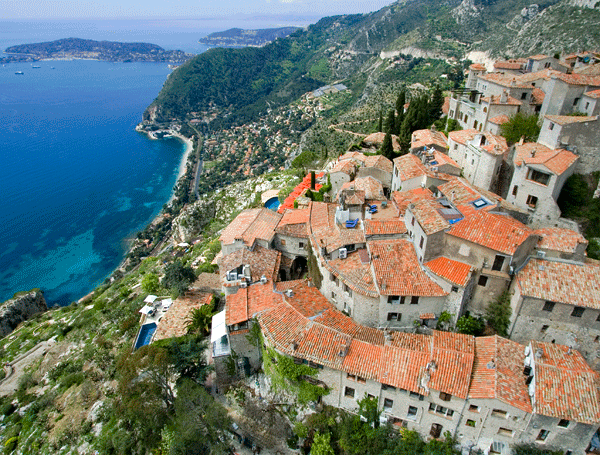
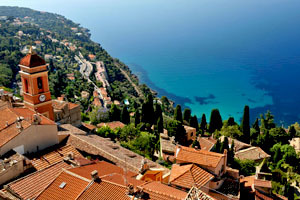
Highlights included a cooking class in Nice, during which we managed to sear duck breasts and fry panisse (while drinking) without burning either ourselves or the food, wandering (full of zabaglione and slightly drunk) through the narrow, winding streets of vertiginous Apricale, Italy, and pretending to be brain-starved zombies while exploring the uber-creepy abandoned WWII Maginot Line bunker in a downpour atop the hill village of Saint Agnes.

We racked up a total of 6 Michelin stars (3 2-star restaurants), two of which rank among the best meals of my life (Chevre d’Or in Eze and Mirazur in Menton).  There was also lots of sleeping, hiking rocky paths round rugged, sun-drenched caps jutting into the Mediterranean, exploring castles, and poking (e.g. eating our way) through the offerings in the morning markets of Menton and Nice.

Given all this, it may surprise you (as it certainly surprised me) to learn I also edited over 150 pages of manuscript.  Apparently I work best when the sun is out and wine is on regular offer.  I think I’ve got about 2 more weeks of work to go and then ABSENT will (FINALLY) be ready to send to readers.  So, that’s awesome.

The one thing that did not happen, either while on vacation or in the 24 hours since I’ve been home, was any sort of preparation for my classes this week.  Sooooo….I’d better get to that!

Keep the wine chilled for me, I’ll be back soon 🙂

Bon voyage!

Well, it wasn’t pretty, but I’ve got a more-or-less completed rough (really, really rough) 2nd draft of my novel, ABSENT.  It’s not in a fit state to send round to my writing group yet.  So, in that sense, I failed to meet my goal 😦

Still, it clocks in at around 80k and is complete enough to print out and take along on my journey over the Atlantic…for which I depart today!

I picture myself sitting on the patio overlooking the azure Mediterranean, sipping wine, and editing away.  A more accurate reality will probably be the replacement of the editing with a mid-afternoon nap, but who knows?  It could happen.

In any case, I won’t be online much for the next 10 days, so I bid you all a fond adieu (for now, at least!) and I’ll see you when I get back (no doubt 10lbs heavier and permanently hungover).

Well…I’m off and missing you all already!  Try to hold down the fort while I’m gone, will you?

Gloriously unrealistic goals

In four days time I’ll be boarding a plane bound from JFK to Nice, France.  That leaves me 4 days to complete the second draft of my archaeological time travel novel, ABSENT, thereby making my self-imposed deadline.  I’ve probably got about 30K to go, which means I’ll need to write/revise around 7.5K per day (not counting teaching classes and getting ready to go on vacation).  So, I probably won’t make it.  But if I love anything, it’s a lost cause.  So I’m pretending I can make it.  I’m going for it.

Because if I do succeed, I bet I’ll enjoy my time here a whole lot more:

To finish, I’ll obviously have to ignore everything but writing.  Soooo, that means I’ll see you, Dear Reader, on Thursday.

Anyone else out there gunning for a wildly unrealistic goal this week?  Do share.

Writer’s Workspace: 3/28

Welcome to this writer’s workspace.  Here’s what’s happening liiiiiiiiiiiiiive at Miranda’s desk:

What I’m working on: only 9 days remain until my self-imposed deadline to complete the second draft of my archaeological time travel novel, ABSENT.  I conferred this morning with my secretary and social planner, Mr. Ramses, and he and I decided the agenda for today was to lay some major pipe.  Word count needs to exceed 3K this afternoon or there’s no way I’m gonna make it.

Snippet from the screen: Black spots appeared in Nick’s vision, peppering his last glimpse of Emily’s pale, determined face before she disappeared from view.

“Be careful,” he whispered.

He and Alexa worked in silence, shoveling away snow, listening to the weight of it groaning up-slope.  He had to stop halfway through and throw up.  Alexa watched him with a deep crease set between her brows. 

“Hey, Detective Stoic.  You determined to kill yourself too?”

He shrugged.  Maybe he was.

In my mug: Tazo Zen green tea, ’cause, you know, antioxidants and stuff.

On the iTunes: I’ve got a little Bruce Springsteen “Thunder Road” action going on over here.  And It. Is. Sweet.

Out my window: Brooklyn’s bout of spring/winter cray-cray ain’t over by a long shot.  Yesterday it was 40.  Today?  65.  I know which I prefer, and global warming be damned.

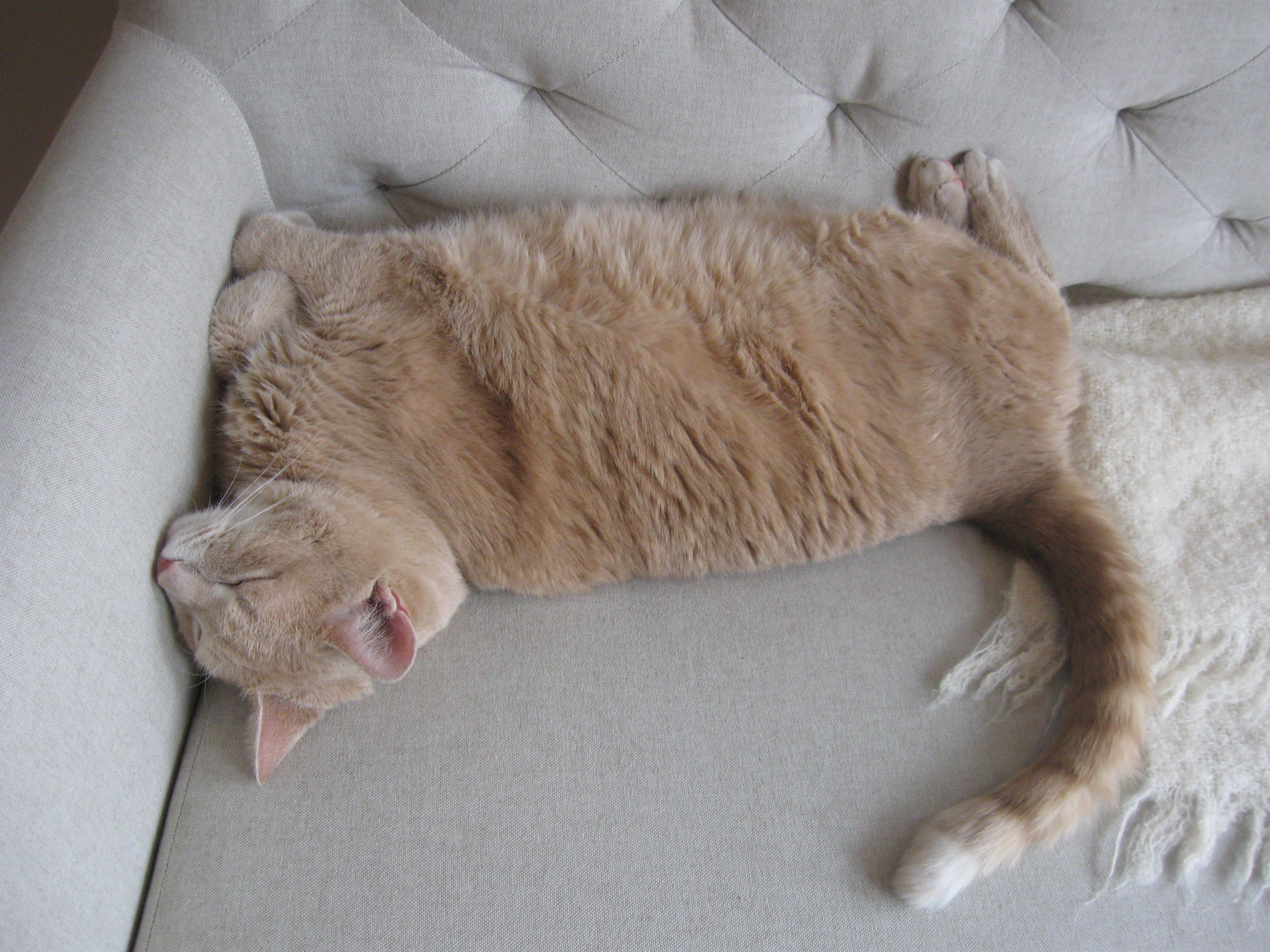
Keeping me company:  the aforementioned secretary/social planner, Mr. Ramses, King of Cats, has abandoned me for his afternoon nap.  Hard to argue with the cute, though.

A little procrastination never hurt anyone:  links for you, my dears!  First up, some musing on the writing life from the awesome Laini Taylor.  Second, the next book in Stacia Kane’s SUPER FABULOUS Downside series is out!  If you haven’t devoured these great books yet, now’s an ideal time to start.  And, finally, for those of you who like being in all your characters’ heads at once…a podcast from Writing Excuses on the omniscient POV.  Enjoy 🙂

What great links do you have to share?  Post em’ in the comments, and while you’re at it, tell me what you’ve got cooking today.

Book Review: Daughter of Smoke and Bone

Daughter of Smoke and Bone by Laini Taylor (2011. 432 pages. YA)

It’s been awhile since a book has cast such a gripping spell on me, but this one managed it (and then some).

Daughter of Smoke and Bone tells the story of Karou, a girl with a mysterious past who lives among hideous monsters who — on the inside — are anything but.  Karou’s life is unusual, sure, but through her art and her tentative friendships, she has found a way to live with one foot in the magical world she shares with tooth-collecting demons and another in the mundane (but never boring) world of modern day Prague.  That is, until a cruel avenging angel steps through a tear in the sky and rains fire and vengeance down on everything Karou knows and loves.  Oh, and he’s her soul mate.

The tag line for this book states: An angel and a demon fell in love.  It did not end well.

True, but…as always, the journey is the thing.

Karou is a wonderful protagonist and Taylor has struck a great balance between Karou’s relatable teenage angst and her sheer ass-kicking awesomeness.  The book is ultimately about Karou discovering who she is and where she’s from, but its sweep takes in eons of history, a grand theological struggle between two races who each see the other as evil incarnate, and a story of love that defies both time and logic.  It’s completely awesome.

Best of all, Laini Taylor knows her way around the written word.  Daughter of Smoke and Bone is lyrically written, lushly described, and a pleasure to read.  My only complaint?  It ends on something of a cliffhanger, leaving the wait for a sequel long and bitter indeed.

This book has been nominated for a Nebula Award and, in my opinion, it is well-deserving of the honor.

Hook me, baby!

Oof.  Writing the beginning of a novel is hard, isn’t it?  I mean, everyone always complains about the dreaded middle or the trouble of nailing the ending, but let’s be honest:  if you don’t hook the reader with your opener, it doesn’t matter what you do with the middle or the end.

Authors, agents, and publishers are perennially asking for hooks:  “Hook me on the first page.  Hook me with the first paragraph.  Hook me in the first line.”  For short stories, this is (slightly) easier to do, but with novels it sometimes feels impossible to strike the proper balance between giving your reader a sense of the characters and grabbing them by the lapels and shrieking YOU WILL BE AMAZED BY THE SKIN-SINGEING THRILLS AHEAD.

This problem has been on my mind of late.  I just finished a submission for a writing workshop I’ll be attending this coming May.  We were allowed to send only 5K in for review and at first I felt very stymied by this.  I’m a novel writer.  How the heck am I supposed to get meaningful feedback on 5K words?  Then I realized if my first 5K doesn’t grab readers at this workshop, it sure as hell isn’t going to pass muster with agents and editors.  This was (gulp) the perfect opportunity to find out if I’d written a good hook.

Problem is, once I really zoomed in on the first 5K in isolation, I began to fret.  The opener was not particularly dramatic and the story has something of a slow reveal.  It’s good stuff (it really is, I swear!), but it isn’t action-packed.  It’s more “strange events unsettle the heroine’s life” than “ghostpigs attack the space station with lasers”.  In the end, I decided that despite being well written and characterized, the opening wasn’t enough of a hook.  I made a late night, last minute change (I mean, those are ALWAYS a good idea, right?) and started with a scene swiped from near the end of the climax, one chocked full of ghostpigs and lasers.  Now I’m biting my nails that this’ll feel like a gimmick or a cheat rather than a clever way to make the reader go: “WHOA! How do we wind up here??”.

I’ll guess I’ll find out if the change worked when I show up for my ritual evisceration at the workshop in a few months.

In the meantime, I continue to ponder the difficulty with novel openings.

How important is it to put your explosions and sparkly vampires in the first paragraph?  How much leeway will your reader allow you to set the scene for what is to follow?  How many pages or paragraphs will really good characters buy you?  Can you start with a few pages of “normal life” before you rip it all out from under the readers’ feet or must you seed all that in as backstory after the king has executed your heroine’s lover in the first paragraph?

Obviously the answers to these questions shift like dandelion seeds in the wind.  How good of a writer are you?  What are the preferences of the agent, editor, or reader who picks up what you’ve written?  Is your book a stand-alone, the first in a series, or the fifteenth?  What phase of the moon is it?

I just don’t know.

All I know is my instincts were telling me my opening was too slow.  I attempted to fix it.  It may turn out my instincts were wrong, or that they were right but my solution was wrong.  Time will tell.

In the meantime, I’d love to hear your thoughts on this.  Anyone else out there struggle with openings?  Should we always lead with change that transforms the protagonist’s life or can we buy a few pages to establish “normal life” before the change comes?  Maybe there’s a happy middle ground I haven’t found yet.  What do you think?